
01 / Design basis
A community of thirty.
A shared way of life.
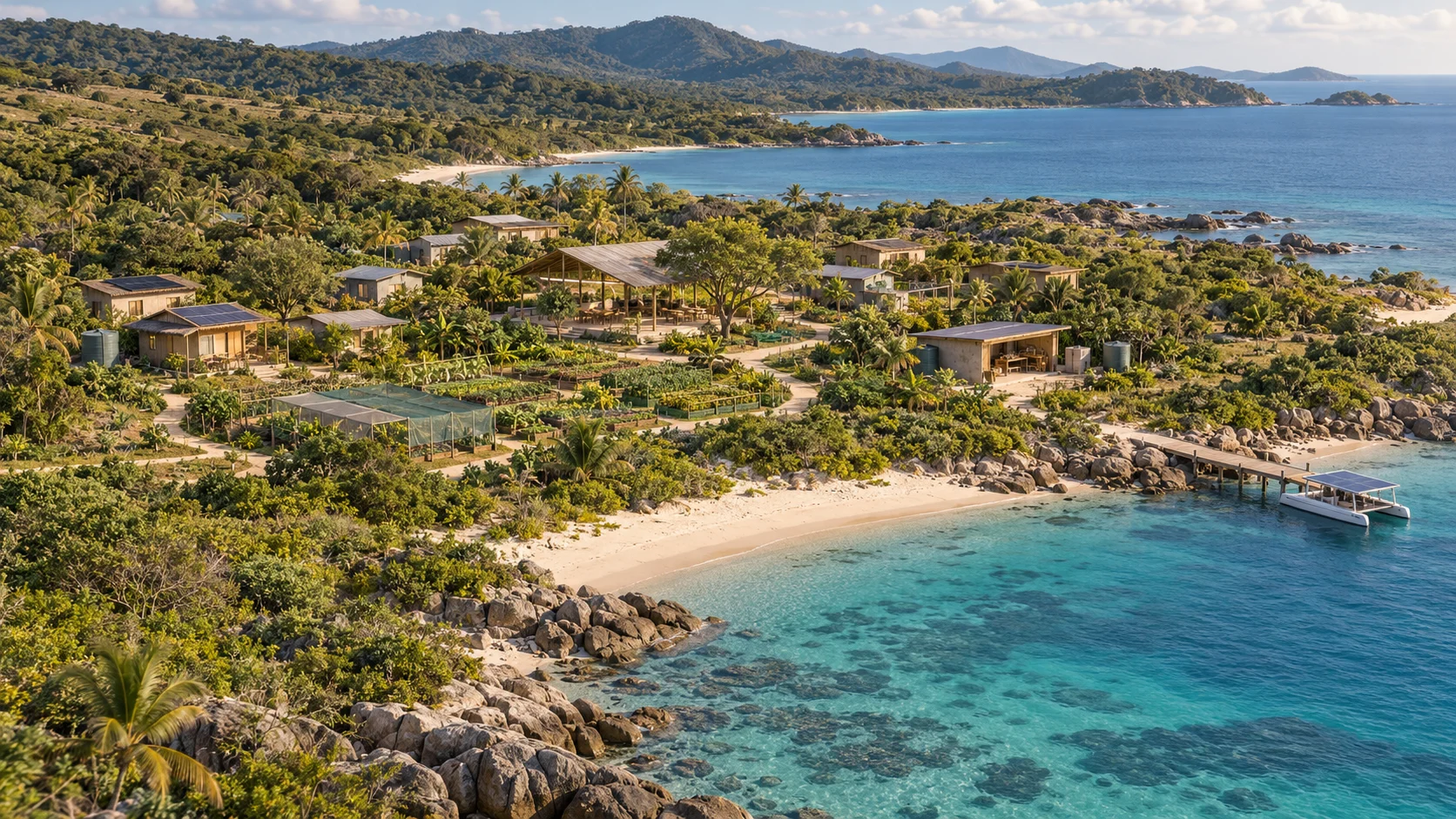
The concept brings thirty people together: residents, guests and working staff combined. Every person is included in the food, water, energy and space requirements.
Five years without outside intervention is an aspiration to test—not a demonstrated capability. Medicine, spare parts, specialist skills, extreme weather and evacuation remain dependencies even when daily power and water are produced locally.
02 / Interdependence
Designed to work together.
Reliable island living connects generation, reserves and skilled maintenance. Designing these systems together helps reveal their shared demands and vulnerabilities.
skills · routines · repair
Concept diagram—not a commissioned system. Construction, farm irrigation, cold storage, wastewater and boats require separate load budgets.
03 / Essential flows
Produce. Store.
Keep a reserve.
Domestic demand, sanitation, irrigation and boat charging cannot be hidden in one average. Emergency drinking-water provision is not a complete water budget.
| Daily requirement | Normal resort | Conservation |
|---|---|---|
| Domestic water | 3.6 m³ | 1.2 m³ |
| Critical nursery water | 6 m³ | 2 m³ |
| Domestic electrical demand | 180 kWh | 60 kWh |
| Additional nursery-water treatment | 36 kWh | 12 kWh |
The reference uses 120 litres of domestic water per person daily in normal mode and 40 in conservation. It excludes full-field irrigation, construction and boat charging. Five litres per person is a separate critical potable allowance, not sufficient total water for hygiene and sanitation.
Rain collection and protected tanks reduce treatment demand; modular seawater reverse osmosis provides another supply path. As an example, 1,200 m² of roof with 2,000 mm annual rain and 80% collection captures 1,920 m³/year. Domestic use plus the critical nursery would need 3,504 m³/year. Even this annual average does not close the balance, and seasonal drought makes storage and treatment more important.
The failure limit matters. At an assumed end-of-life usable AC capacity of 249 kWh, the proposed battery supports about 3.46 conservation days with no solar. Seven days at 0.5 equivalent peak-sun-hours/day uses about 202 kWh of reserve; fourteen such days needs about 403 kWh and fails this battery-only scenario. It is not five years of stored electricity.
Victron Lithium NG ↗
5.12 kWh module example; the concept models 80 modules, separate banks and explicit ageing/usable-energy assumptions. Final protection and thermal design require engineering.
MANUFACTURER · WATERSpectra LB2800M ↗
Datasheet example: 444 litres/hour and 1.2 kW. Concept uses derated modular duty/standby operation and a conservative whole-chain allowance; site water tests and complete manuals are still needed.
MANUFACTURER · WATER FROM AIRWatergen GEN-M1 ↗
A real atmospheric-water product to evaluate, not a substitute for a full water budget. Output and energy depend strongly on heat and humidity.
PUBLIC HEALTH · RAINWATERCollection is not potability ↗
Rain and condensate require appropriate treatment, storage and water-quality verification.
Why not simply drink dehumidifier water?
Removing humidity and producing safe drinking water are different jobs. Ordinary dehumidifier condensate is not automatically potable. An atmospheric-water generator needs a complete sanitary treatment and testing system; its energy intensity makes it a supplementary option rather than the assumed bulk source here. The supplied social video was not accessible, so no particular machine in that video has been identified or verified.
Water treatment also needs filters, membranes, cleaning supplies, sensors and trained operators. Stored chemicals, test reagents and batteries age. A five-year spare-parts quantity does not establish five-year shelf life or repairability. Current equipment prices and landed installation costs remain quote-required.
04 / Living systems
Grow a richer island life.
Fresh greens, tropical staples and seasonal variety can bring food production into daily island life. A complete food plan must also balance calories, protein and fats with soil, water, labour and storage. Fishing remains an uncertain supplement, not a guaranteed harvest.
The working crop portfolio combines tropical staples, legumes, fruit, vegetables and oil crops. The land allowance is a screening model with uncertain yields, rotation and access needs; soil, salinity, usable land and two wet/dry crop cycles must be tested. It is not a claim that any listed island can feed thirty people.
At 20 grams per person per day, microgreens provide variety rather than staple calories: even a generous energy assumption contributes less than 0.5% of the daily total. Seed, clean water, safe substrate, hygiene and labour are recurring inputs. Wild fish receives zero guaranteed credit in the baseline: lawful access, weather, ecology and safe species selection all matter.
At an assumed 4 mm daily drought deficit across five hectares, irrigation would need 200 m³/day before application losses. The small water system described above does not support that. Rainfed production, stored reserves and a much smaller critical nursery are therefore assumptions requiring climate and crop validation.
An illustrative five-year food-energy reserve is about 44 tonnes of blended dry-food equivalent after a 15% loss allowance. That is not a balanced menu or validated five-year shelf life. Oil stability, micronutrients, seed viability and hot-humid storage remain unresolved dependencies.
Microgreens in context ↗
Production inputs and practical crop handling.
FAO · WATERWater and land area ↗
Why field irrigation cannot disappear inside a domestic budget.
EXTENSION · STORAGEStorage conditions ↗
Heat and moisture affect food quality and storage life.
CDC · FOOD SAFETYMarine food risks ↗
Local risk assessment matters; cooking does not remove every marine toxin.
05 / Shelter
Learn from the ground.
Design for the climate.
TECLA offers an inspiring example of earth-based 3D printing and climate-responsive architecture. Adapting that approach to a tropical island begins with local materials, exposure and site-specific engineering—not copying an Italian prototype.
The architect describes a roughly 60 m² prototype and climate-specific envelope design. Published printing-time claims differ: MCA gives 72 hours per unit, while WASP reports 200 printing hours. Neither is a complete, serviced, approved building schedule.
TECLA / MCA ↗
Climate-responsive envelope and the distinction between design research and a repeatable island home.
MANUFACTURER · PROJECTTECLA / WASP ↗
Printing-process metrics, materials and specialist contributors—not a turnkey resort specification.
MANUFACTURER · EQUIPMENTCrane WASP ↗
Advertised from €160,000 for equipment; shipping, completed homes, services and approvals are separate.
RESEARCH TEAM · SITE LOGLearning by building ↗
Actual mix preparation, extrusion, weather and nonprinted foundation work.
Planning judgment: test one instrumented pilot before replication. Local soils, wet strength, salt exposure, wind, flood, foundations and permissions need qualified site-specific assessment. No cyclone or flood certification is represented.
06 / Local connection
Stay in touch.
Keep knowledge close.
Low-bandwidth mesh can support local text and location sharing without mobile service. It is not broadband internet or a guaranteed emergency distress system. Terrain tests, lawful radio settings, spare batteries and independently powered relays matter.
A local reference library can keep manuals accessible offline. AI-assisted retrieval must identify its sources and cannot replace trained medical, engineering or operational judgment.
07 / Marine access
A quieter passage.
A considered connection.
Solar-electric catamarans offer an intriguing connection between island life and the wider world. Weather, charging and maintenance still shape every journey. Guest transfers, supplies and medical evacuation need separate operating plans; a luxury catamaran is not automatically licensed to evacuate thirty people.
08 / The human layer
Resilience is practiced.
Repair skills, inspection routines, drills, consumables and replacement parts deserve the same attention as solar panels. Build redundancy in people, not only equipment.
- Train at least two competent people for each critical function, within the thirty-person ceiling. A staffing allowance is not evidence that a luxury resort and an intensive farm can run simultaneously.
- Keep a physical spares ledger: component, installed count, spare count, expected life, storage conditions, replacement skills and failure consequences. Money reserved for replacements is not a spare pump during isolation.
- Separate potable and nonpotable water, food storage, sanitation and waste flows. Local engineering, food-safety and ecological reviews remain necessary.
- Rotate food, seed and medical stocks against their actual shelf lives. Offline manuals complement training; they do not replace clinical care or qualified repairs.
Test a missed resupply, pump failure, failed harvest and cold-store outage before making stronger claims. A ninety-day trial and a full seasonal year are useful evidence—not proof of five years. Severe illness or injury can still require outside treatment; a marketing goal must never override health or evacuation.
09 / Feasibility
A compelling vision.
An accountable model.
A lasting island community needs an operating model as thoughtful as its design. Explore how occupancy, hospitality rates, staffing and reserves affect the concept, with capital costs and external dependencies considered separately.
The illustrative hospitality model allocates 18 guest places and 12 resident/support places within thirty total occupants. It assumes 330 sellable nights annually. These are scenarios, not confirmed demand, a staffing plan or an approved layout.
| Scenario | Occupancy | Full-board rate / person / night | Cash after assumed reserve* |
|---|---|---|---|
| Downside | 35% | $280 | −$472,017 |
| Base | 55% | $340 | −$85,323 |
| Upside | 75% | $420 | +$509,865 |
*Assumes $20 ancillary revenue and $95 variable cost per sold guest-night, distribution costs of 10% of lodging revenue, $720,000 fixed annual costs and $120,000 replacement reserve. All costs and occupancy are unquoted planning assumptions. Excludes land/lease, debt, taxes, depreciation, initial strategic inventory, extraordinary disaster costs and other project costs. These exclusions can eliminate the upside. Not net profit, yield or investor return.
At the base rate, the model breaks even around 61.2% occupancy before those excluded costs. Capital cost remains quote-required. A separate disruption case must allow tourism income to fall to zero; financial break-even does not establish physical resilience.
Chumbe Island ↗
Seven eco-bungalows provide a small-scale hospitality reference. Local food sourcing and waste exports are external dependencies; public rates are not achieved profitability.
OPERATOR · COMPARABLEThe Brando ↗
Integrated energy, cooling and gardens illustrate systems thinking—not five years without resupply.
RESEARCH · EDUCATIONTetiaroa Society ↗
Research and learning can sit alongside hospitality; no partnership or grant is assumed here.
OPERATOR · COMPARABLETitiru Eco Lodge ↗
A modest-comfort tropical approach; solar lighting alone is not complete energy independence.
Bring your island vision into focus
Early-stage site research and feasibility coordination can turn a broad ambition into a focused brief: compare locations and system options, organize public-source evidence and identify the questions for qualified local specialists. This support is research and coordination, not certified engineering, legal or investment advice.
Start with a site brief
Start with the place, the people and the kind of life you want to create. A focused brief brings together your candidate island, total occupancy, intended service level and the questions that matter most—then identifies the independent checks needed before design or commitments.
No enquiry form or booking service is active on this page. Potential landowners, operators, technical contributors and investors are invited to explore the idea; none are represented as existing partners. No investment, membership, property interest or guaranteed refuge access is offered.
10 / Before a vision becomes a place
From a compelling idea
to a considered plan.
- Select and survey a suitable site; establish ownership, buildable area and permissions.
- Reconcile demand, generation and reserves with seasonal and failure scenarios.
- Test local materials, equipment maintainability and essential skills.
- Verify safety, ecology, operating costs and evacuation with qualified local advisers.
- Pilot, measure and revise before scaling.
Sources reviewed 30 October 2026. Manufacturer statements are attributed examples, not independent certification. No selected site or approved development is implied. Original concept art does not depict an actual property.